


Products
+86 19983142162
Online customer service Immediate consultation
Leave a message for consultation:
-

HBG Series – Large-Scale Electro-Hydraulic CNC Press Brake
Standard equipment includes a multi‑V lower die, with options for various opening widths and profile dimensions; die changes are quick and easy, enabling conventional sheet‑metal bending operations while delivering superior cost performance. -

Four-Column Universal Hydraulic Press
It is primarily used for stamping and forming of both metallic and non-metallic materials, and is also suitable for compression molding of powders and composite materials. -

Yz32 Four-Column Universal Hydraulic Press
This series of hydraulic presses is suitable for processes such as tensile testing, bending, flanging, cold extrusion, blanking, straightening, and press fitting of metallic materials. It is also applicable to the compression molding of powder‑based and abrasive products, as well as to the compression molding of plastic products and insulating materials. -

Yz12 High-Speed Free Forging Hydraulic Press
1. Free forging is suitable for large forgings with simple shapes, such as the production of various large shafts, rings, and discs.
2. It is applicable to the forging of carbon steels, alloy steels, tool steels, bearing steels, stainless steels, and high‑temperature alloy steels.
3. It finds applications in aerospace, power generation, railway and mining, shipbuilding, and transportation industries. -

Thermoforming hydraulic press
It is primarily used for hot stamping of high-strength steels in the automotive industry, such as the A- and B-pillars, front and rear anti‑collision beams, and other high-strength steel components on vehicle bodies. -

Yz14 forging hydraulic press
1. Applicable to forming processes for various die-forged parts, aluminum alloys, titanium alloys, and other products;
2. Suitable for industries such as automotive, aerospace, shipbuilding, transportation, and oil‑field piping. -
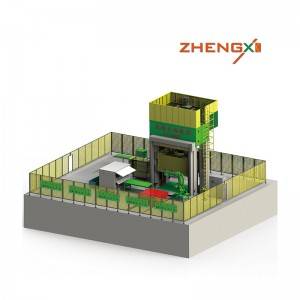
Automatic production line
This machine is mainly suitable for composite material molding; the equipment has good system rigidity and high precision, high life and high reliability. The process for hot press forming meets 3 shifts/day production. -

YD1400/YD2500 Multi-Side Bending Center
The flexible press brake center can operate independently, efficiently producing components of various specifications. Its universal dies require no adjustment time; they automatically adapt to the dimensions specified in the program, ensuring operator safety and product quality. The positioning process is performed only once—at the start of each bending cycle—and remains unchanged throughout the entire operation, from initiation to completion. With a resolution of 0.01 degrees, it delivers exceptional production flexibility. -

Open-type vertical slotting machine
The open‑type slotting machine is an upgraded version of conventional equipment. Compared with traditional machines, its key features are heavy‑duty operation, high speed, and high efficiency. -

YT1500 Intelligent Tool Magazine Bending Center
It focuses on addressing complex sheet‑metal bending challenges in metal forming, leveraging multi‑axis simultaneous motion to automate sheet‑metal operations. By eliminating reliance on dies and manual labor, this technology significantly boosts production efficiency and reduces manufacturing costs. It effortlessly handles arc bends, edge‑crimping, U‑shaped bends, closed‑profile bends, and other intricate sheet‑metal bending requirements. -

CNC hydraulic shearing machine
The frame features a welded steel‑plate structure and undergoes full annealing to relieve internal stresses.
Hydraulic transmission with nitrogen‑assisted return; easy operation and reliable performance. -

HB Series – Electro-Hydraulic Servo CNC Press Brake
The equipment’s main body is machined from Q355B steel, increasing its strength by 1.5 times.
After welding, the entire unit undergoes annealing, enhancing its durability.


